Abstract
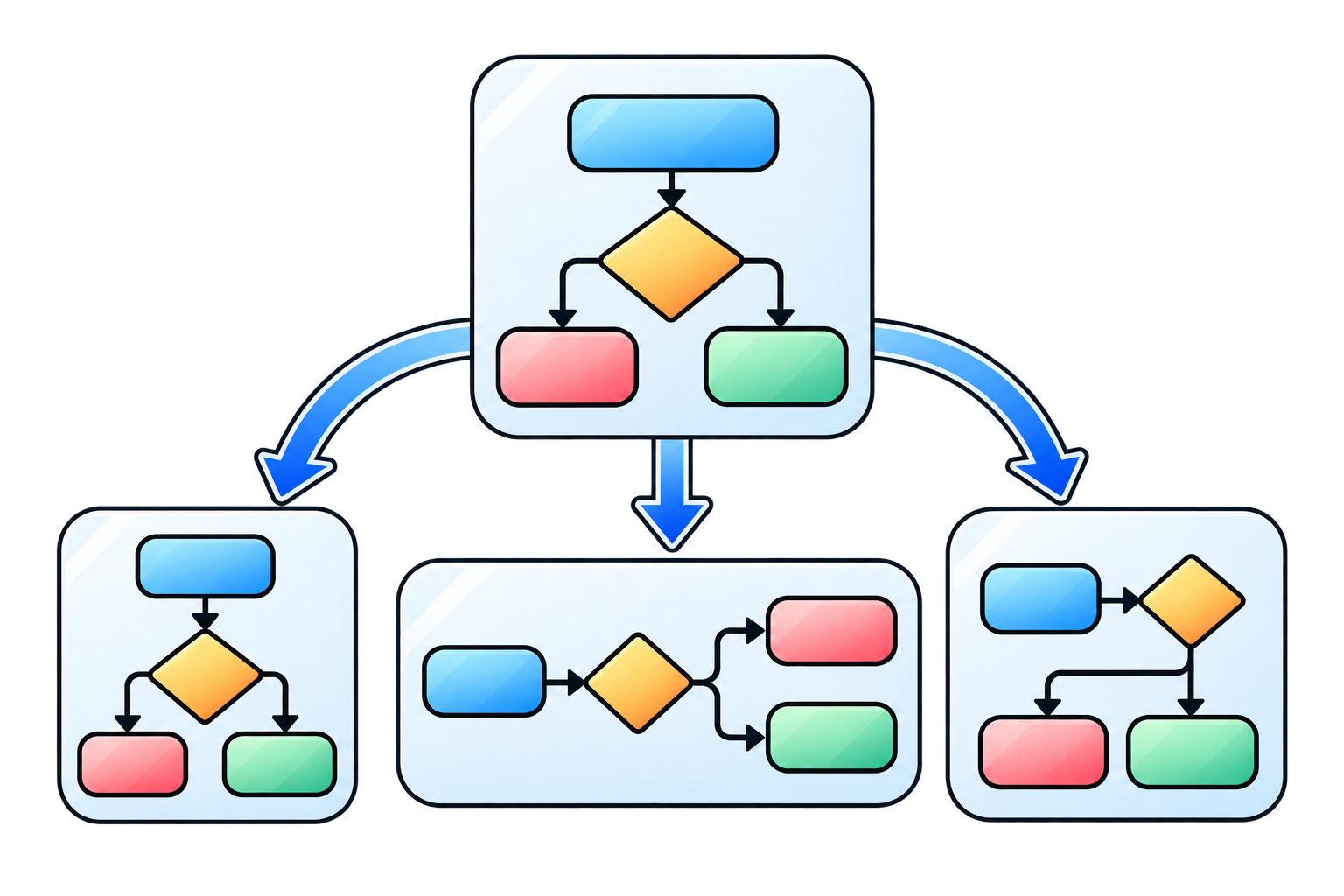
Pipeline figures in ML papers must be repurposed across many canvases, including paper columns, 16:9 slides, portrait posters, 1:1 social teasers, 9:16 phone previews. Each format imposes a different aspect ratio on the same computational graph, where any silently broken connection misrepresents the method. We formulate aspect-ratio-adaptive flowchart relayout as a distinct task: given a raster flowchart and a target ratio, produce a structurally faithful, hallucination-free, editable layout. Existing methods fail characteristically: image-to-image models stretch blocks and reject extreme ratios, text-to-image agentic systems hallucinate content, and parse-then-render systems mis-route edges. We propose an agentic pipeline factored into Parse, Style, and Layout stages, each pairing a main agent with a critic that combines deterministic constraint checks with VLM visual feedback so connectivity is explicitly checked and prevented from being silently broken. Outputs are draw.io-editable mxGraph XML. On a curated benchmark of 100 flowcharts at five aspect ratios, evaluated by Gemini 3.1 Pro and validated against human judgments, our method reaches 68.6% Content Fidelity versus 11.2–41.4% for prior work.
Contributions
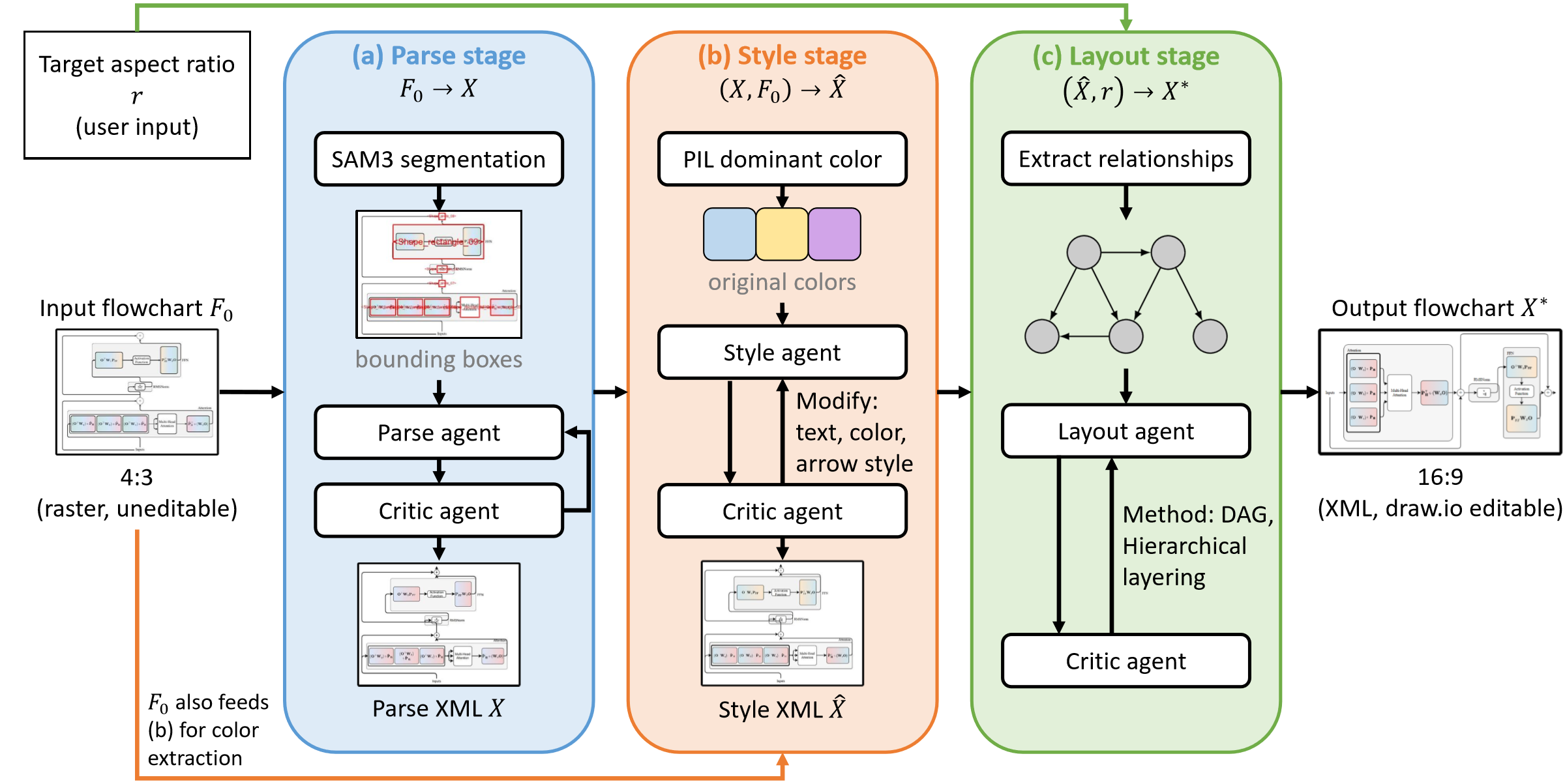
- We formulate aspect-ratio-adaptive flowchart relayout as a distinct task and propose the first agentic pipeline for it, factored into Parse, Style, and Layout stages, each guarded by a critic combining VLM reasoning with deterministic verification so connectivity is explicitly checked and prevented from being silently broken.
- We construct FlowchartRelayoutBench, a benchmark pairing flowcharts from CVPR/ICCV/ECCV/NeurIPS/ICLR/ICML oral papers at five target ratios (9:16, 2:3, 1:1, 3:2, 16:9) with a four-metric VLM-as-a-Judge protocol (Relationship Preservation, Hallucination-free Rate, Layout Quality, Style Similarity) validated against human assessments.
- Experiments and a user study show that our pipeline substantially outperforms both monolithic VLM and existing agentic figure systems on the structural-fidelity dimensions that matter most for cross-canvas relayout.
Method Overview
Three stages transform a raster flowchart into an editable diagram for a new canvas. Each agent works with a critic to verify structure, visual appearance, and layout. Intermediate and final representations remain in draw.io-compatible mxGraph XML.
Experimental Results
FlowchartRelayoutBench evaluates 100 flowcharts at five target aspect ratios along four dimensions: Relationship Preservation checks connector sources, targets, and flow direction; Hallucination-free Rate checks that no elements are added or omitted; Layout Quality evaluates canvas utilization and arrangement; and Style Similarity evaluates colors, text, and connector styles. The first two are pass/fail metrics; the latter two are average ranks, where lower is better.
Qualitative Comparisons
Aspect-ratio adaptation across ten pipeline diagrams, compared with four image-generation and diagram-editing baselines.
Ours
Baseline
More Canvas Results from Ours
Our XML-based pipeline adapts the same ten diagrams to additional canvases: 2.39:1, a cinematic widescreen aspect ratio, and 1:4, an extreme portrait aspect ratio, while preserving structure and draw.io editability. VLM-driven image-generation baselines have limited support for arbitrary canvas ratios; the 1:4 target falls outside the approximately 3:1 to 1:3 range reported in our paper.
Ablation Result
On a balanced subset of 30 flowcharts, we study three categories: direct prompting versus multi-stage decomposition, Style Stage and Critic Agent removal, and replacing the Layout Stage with Graphviz DOT. The comparisons below correspond to the qualitative ablation figures in the paper appendix.
Style Transfer Result
An additional reference-guided Style Transfer stage restyles a completed relayout using an unrelated reference image. Colors, typography, corners, and arrows change while diagram structure and semantic content remain intact.
BibTeX
@misc{onefigureeverycanvas2026,
  title={One Figure, Every Canvas: Editable Flowchart Relayout via Agentic Pipeline},
  author={Shih-Chen Tseng and Chih-Hsuan Chen and Ryan Yang and Hsi-An Chen and Chun-Wei Tuan Mu and Yu-Lun Liu},
  year={2026}
}